
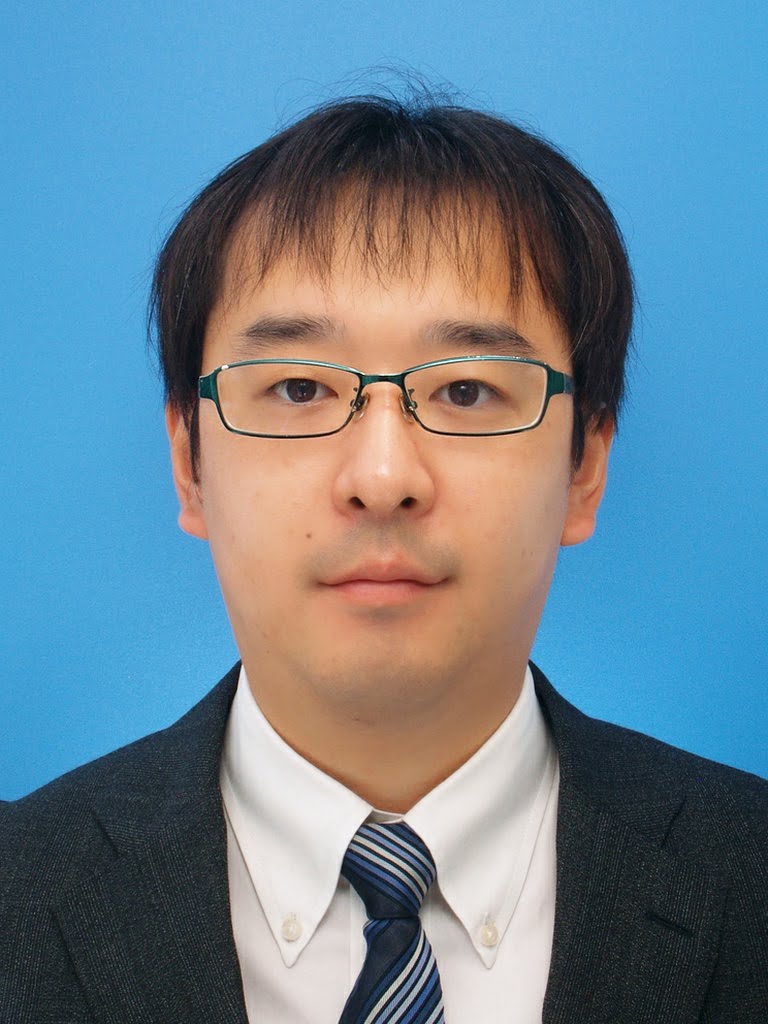
|
Affiliation |
Faculty of Informatics and Data Science Department of Informatics and Data Science |
|
Mail Address |
|
NANSAI Shunsuke
|
|
|

Research Interests 【 display / non-display 】
-
Robotics and Mechatronics
-
Robotics and Mechatronics
-
Control Engineering
Graduating School 【 display / non-display 】
-
-2011.03
Tokyo Denki University Graduated
Graduate School 【 display / non-display 】
-
-2015.03
Tokyo Denki University Doctor's Course Completed
-
-2013.03
Tokyo Denki University Master's Course Completed
Degree 【 display / non-display 】
-
Tokyo Denki University - Ph.D (Engineering)
Campus Career 【 display / non-display 】
-
2026.10-Now
Akita University Faculty of Informatics and Data Science Department of Informatics and Data Science Associate Professor
-
2025.04-2026.09
Akita University Faculty of Informatics and Data Science Department of Informatics and Data Science Lecturer
-
2023.04-2025.03
Akita University Office for Establishment of New Faculty Lecturer
Academic Society Affiliations 【 display / non-display 】
-
2015.07-Now
Japan
The Robotics Society of Japan
Research Areas 【 display / non-display 】
-
Manufacturing Technology (Mechanical Engineering, Electrical and Electronic Engineering, Chemical Engineering) / Control and system engineering / ロボット工学,制御工学
Thesis for a degree 【 display / non-display 】
-
Nested Reconfigurable Modules for Multi-robot System
南斉俊佑
2015.03 [Refereed]
Single author
Research Achievements 【 display / non-display 】
-
Development of an Endoscopic Inspection Module for Observing the Inner Wall of Small-Diameter Pipes
Hirasawa Shota, Nansai Shunsuke, Hoshizaki Midori, Seki Takesi, Naganawa Akihiro
The Japanese Journal of the Institute of Industrial Applications Engineers ( The Institute of Industrial Applications Engineers ) 14 ( 2 ) 107 - 114 2026.09 [Refereed]
Research paper (journal) Domestic Co-author
This study introduces a compact rotating camera head with an oblique mirror for internal inspection of small-diameter pipes. Mirror rotation bends and sweeps the field of view, enabling steerable side viewing and localized, magnified observation of target regions that forward-looking optics often miss. A dedicated image-processing pipeline compensates illumination nonuniformity and sensor variability, suppresses texture-driven background, and emphasizes linear defects through filtering, binarization, morphological operations, and labeling. Pixel-to-length calibration converts image measurements into physical dimensions to estimate defect size, integrating observation and metrology. Prototype evaluations indicate stable extraction under varied conditions, supporting condition monitoring and preventive maintenance in confined spaces.
-
Feasibility Study on Estimating the Stiffness of Simulated Arterial Vessels Using a Balloon Catheter
Midori Hoshizaki, Shunsuke Nansai, Masataka Takahashi, Akihiro NAGANAWA
Advanced Biomedical Engineering ( 公益社団法人 日本生体医工学会 ) 15 ( 0 ) 359 - 367 2026.06 [Refereed]
Research paper (journal) Domestic Co-author
<p>Arterial stiffness is used to diagnose atherosclerosis. The most commonly used estimation methods are indirect and non-invasive. To develop a method for direct measurement of the stiffness of blood vessels, stiffness estimation was performed on four simulated blood vessels with different stiffnesses values using a balloon catheter employed in the treatment of atherosclerosis. To measure the pressure response during balloon dilation in a simulated blood vessel, a pressurization and pressure measurement device was fabricated to pressurize the balloon catheter at a constant speed while measuring the pressure. To calculate Young's moduli of the simulated vessels, we simultaneously measured the pressure responses of the simulated blood vessels and the changes in circumferential length of the vessels using a microscope. A tensile test was also used to measure the Young's moduli of the simulated vessels. The Young's modulus values obtained by the balloon catheter method and the tensile test were compared. A linear relationship was observed between the Young's moduli determined by the two tests, indicating that the balloon catheter method can be used to estimate the Young's modulus of simulated blood vessels. To develop a simple method for estimating vessel stiffness, we calculated the reaction force received from a simulated vessel using the pressure difference during dilation in three balloon catheters with different diameters. We then evaluated whether the stiffness could be estimated by comparing the measured pressures with the Young's modulus values. Both the peak pressure after pressurization and the steady-state pressure during pressurization were related to the Young's modulus values, although the relationship depended on the diameter of the balloon catheter. Therefore, we suggest that it is possible to obtain values that reflect the Young's moduli of blood vessels using the balloon catheter method. These results suggest that with appropriate optimization of the balloon catheter diameter relative to the vessel diameter, this approach has the potential to provide pressure response values reflecting the stiffness of blood vessels.</p>
-
Shunsuke Nansai, Norihiro Kamamichi, Akihiro Naganawa
Journal of Control, Automation and Electrical Systems ( Springer Nature ) 37 ( 5 ) 1104 - 1124 2026.06 [Refereed]
Research paper (journal) Domestic Co-author
-
Shunsuke Nansai, Norihiro Kamamichi, Akihiro Naganawa
Automation ( Multidisciplinary Digital Publishing Institute (MDPI) ) 6 ( 4 ) 2025.11 [Refereed]
Research paper (journal) Domestic Co-author
-
Design and evaluation of Lizard-Inspired Single-Actuated robot
Shunsuke Nansai, Norihiro Kamamichi
ROBOMECH Journal ( Robomech Journal ) 12 ( 16 ) 2025.05 [Refereed]
Research paper (journal) Domestic Co-author
-
A Survey of Wall Climbing Robots: Recent Advances and Challenges
Shunsuke Nansai, Rajesh Elara Mohan
Robotics 5 ( 3 ) 2016.07 [Refereed]
Introduction and explanation (scientific journal) International Co-author
-
Development of a Non-invasive Device for Evaluating Mastication Based on Masseter Muscle Dynamics and EMG
Yamato Kikawa, Midori Hoshizaki, Shunsuke Nansai, Takeshi Seki, Akihiro Naganawa
Proceedings of the 13th IIAE International Conference on Intelligent Systems and Image Processing 2026 259 - 266 2026.09 [Refereed]
Research paper (international conference proceedings) Domestic Co-author
-
Autonomous Approach System Using Voice Commands and Object Recognition for a Commercially Available Quadruped Robot
Sara Ishida, Midori Hoshizaki, Shunsuke Nansai, Takeshi Seki, Akihiro Naganawa
Proceedings of the 13th IIAE International Conference on Intelligent Systems and Image Processing 2026 273 - 279 2026.09 [Refereed]
Research paper (international conference proceedings) Domestic Co-author
-
Development of a Miniaturized Eye Movement Device in Orbital Prosthesis
Rio Shibata, Midori Hoshizaki, Shunsuke Nansai, Takeshi Seki, Kimihiko Narita, Hiroshi Takano, Akihiro Naganawa
Proceedings of the 13th IIAE International Conference on Intelligent Systems and Image Processing 2026 280 - 286 2026.09 [Refereed]
Research paper (international conference proceedings) Domestic Co-author
-
Verification of Probe Orientation Operation Using a Wireless IMU for a Teleoperated Echocardiography Robot
Sakura Ono, Wakana Sato, Midori Hoshizaki, Shunsuke Nansai, Takeshi Seki, Hiroyuki Watanabe, Akihiro Naganawa
Proceedings of the 13th IIAE International Conference on Intelligent Systems and Image Processing 2026 287 - 292 2026.09 [Refereed]
Research paper (international conference proceedings) Domestic Co-author
-
Non-linear Least Square Method for Lizard-Inspired Single-Actuated Robot
Shunsuke Nansai, Norihiro Kamamichi, Akihiro Naganawa
The 44th JSST Annual International Conference on Simulation Technology 209 - 212 2025.09 [Refereed]
Research paper (international conference proceedings) Domestic Co-author
-
Path Following Control of 1-DOF driven robot utilizing Non-linear Least Square Method
Shunsuke Nansai
855 - 858 2025.12
Research paper (research society, symposium materials, etc.) Single author
-
Development of a probe gripper with a safety mechanism for a remote ultrasound diagnostic robot
2025.12
Research paper (research society, symposium materials, etc.) Domestic Co-author
-
Development of orbital epithesis for realizing eye movement and blink
Shota Hirasawa, Midori Hoshizaki, Shunsuke Nansai, Kimihiko Narita, Hiroshi Takano, Akihiro Naganawa
2025.09
Research paper (research society, symposium materials, etc.) Domestic Co-author
-
Development of an Endoscopic Head for Observation in Confined Spaces
Shota Hirasawa, Midori Hoshizaki, Shunsuke Nansai, Takesi Seki, Akihiro Naganawa
2025.09
Research paper (research society, symposium materials, etc.)
-
Development of orbital epithesis for realizing eye movement
2024.09
Research paper (research society, symposium materials, etc.) Domestic Co-author
◆Original paper【 display / non-display 】
◆Introduction and explanation【 display / non-display 】
◆International conference proceedings【 display / non-display 】
◆Research society, Symposium materials, etc.【 display / non-display 】
Academic Awards Received 【 display / non-display 】
-
Best Paper Award
2025.02 The Institute of Industrial Applications Engineers
-
Research Award
2022.08
Grant-in-Aid for Scientific Research 【 display / non-display 】
-
Grant-in-Aid for Scientific Research(C)
Project Year: 2026.04 - 2031.03
-
Improvement of the performance of a multi-legged robot driven with one degree-of-freedom by a new morphology
Grant-in-Aid for Early-Career Scientists
Project Year: 2021.04 - 2026.03
Presentations 【 display / non-display 】
-
Clock-bot: A Swing-up and Stabilization Control of a New Pendulum Robot
Shunsuke Nansai
22nd IFAC World Congress 2023.07 - 2023.07
-
Wall Climbing Robots for Building Inspections
Shunsuke Nansai [Invited]
2nd International Conference on Future of AM 2026.08 - 2026.08
-
Non-linear Least Square Method for Lizard-Inspired Single-Actuated Robot
Shunsuke Nansai
The 44th International Conference on Simulation Technology 2025.09 - 2025.09 日本シミュレーション学会
-
Path Following Control of Lizard-Inspired Single-Actuated Robot\\based on Non-linear Least Square Method
Shunsuke Nansai
The 2025 SICE Festival with Annual Conference 2025.09 - 2025.09 計測自動制御学会
-
Trajectory Tracking Control of Lizard-Inspired Single-Actuated Robot -Tracking on Circular Trajectory-
Shunsuke Nansai
The 43rd JSST Annual International Conference on Simulation Technology 2024.09 - 2024.09
Academic Activity 【 display / non-display 】
-
2025.04-2026.03
-
2025.03-Now
-
2025.01-Now
-
2024.12-2025.03
-
2024.04-2025.03